Showing posts with label Music. Show all posts

Monday, May 18, 2026

Gigantic: They Might Be Giants Concert Review

I saw They Might Be Giants perform at The Vic in Chicago on Saturday, May 2nd.


Who are They Might Be Giants? Their name is presumably inspired by the 1971 film starring George C. Scott and Joanne Woodward. The title refers to Don Quixote mistaking windmills for giants. I saw the movie decades ago. The IMDB synopsis is:

"In a Manhattan psychiatric hospital, a man convinced that he is Sherlock Holmes is treated by a female doctor who happens to be named Watson."

A review on IMDB says "This sweet, goofy, and fairly romantic film asks the questions 'Whose reality is right?' and 'Does it really matter?'"

I say that many They Might Be Giants (TMBG) songs are goofy, some are sweet, and some are even romantic. The lyrics and the music are quite clever and sophisticated. Some of the lyrics can be paranoid, others like science fiction or Kurt Vonnegut, others absurd or like the writing of Donald Barthelme; others are just quirky; some seem drug-referential or drug-inspired; some are straightforward. They are humorous, but I wouldn’t call them comedy rock.

John Linnell and John Flansburgh started TMBG as a duo in Brooklyn in 1982, Flansburgh on guitar and Linnell on accordion, keyboards, and assorted other instruments. They performed as a duo and sometimes used backing tapes or drum machines. In 1983, they began a service called Dial-a-Song, advertised in local papers. People called and got an answering machine which played them (part of) a song. Eventually, they put out a self-titled album in 1986, heard on some college radio stations. Their second album, Lincoln, had a song that broke through to commercial FM radio, such as WXRT in Chicago, where I first heard its single, "Ana Ng." I bought the album and enjoyed it immensely. Their next album, 1990's Flood, became their classic, including "Birdhouse in Your Soul," "Particle Man," and a cover of "Istanbul (Not Constantinople)." It would be the album they would later base a tour on, playing the entire album. 

I'll not list their 24 studio albums released over four decades, nor their dozens of live albums, EPs, or compilations, many including previously unreleased songs. They played 31 songs from 15 different records at the 2026 show I saw. 

In 2002, they won the Grammy for Best Film or Television Theme for "Boss of Me" for the Malcolm in the Middle TV comedy, which you may have seen or heard. Also, in 2002, a documentary film appeared about them, Gigantic (A Tale of Two Johns). They have also put out several children's albums like No! and Here Come the ABCs. In 2003, I saw the band perform at Naperville’s “Last Fling” with family: Cathleen, Conor, Liam, Brendan, Barry, and Yvonne. 

They Might Be Giants at The Vic: John Linnell at the keyboard,
John Flansburgh on guitar in front of the drummer.

On this tour, they have a three-piece horn section, in addition to the core five-piece band. They play two sets with no opening band. The first set highlights one of six of their first eight albums, and the second set is more varied. The featured album would not be  announced in advance. I know all of their albums fairly well, with the exception of their fifth album, John Henry, which was on the list of options. I had found it a difficult album, which I attributed to their changing from a two-person band to a "real" five-piece rock band. To prepare for the concert, I listened to John Henry more than some of the other albums, which turned out to be prescient because that was the album they featured. Also, I found that it was not a bad album at all. 

At the concert, they started with nine songs from John Henry. The first, "Subliminal," I found a little confusing, because it has overlapping vocals (kind of subliminal). However, I knew this, and it seemed that the entire audience was familiar with all of the songs, and it is the first song on the album. The second song, "Snail Shell," was very strong, and struck me as a better song to open with. What I love about TMBG is that who else would have a chorus like "I want to thank you for putting me back in my snail shell." Some fans put mental energy into lyric interpretations (see https://tmbw.net/wiki for this song), but the lyrics often just make me smile. 

There was much enjoyable banter, easy in the way 44 years can make it. At one point, John F picked up the John Henry album cover from a guitar stand and mentioned that they were featuring it in the first set and handed it to someone in the non-mosh pit, deadpanning "I'm gonna need that back." (He didn't.) Later, just before beginning a song, the drummer had to adjust the top cymbal of the hi-hat, making the band wait. John F said to John L that reminded him of a conversation the band was having about momentum. John L said he associated the band more with inertia. Later, they brought up the house lights to determine the audience beard-to-glasses ratio (they would wait until the third night in Chicago to complete the data set). Another conversation involved meeting with Disney, where every department, including Disney on Ice, introduced themselves. I can only assume that might have to do with their children’s albums.

The set continued with “Unrelated Thing,” a slower song about miscommunication, then the upbeat Latin-tinged horn-heavy “No One Knows My Plan,” in which the protagonist sings from a prison cell, asserting that it’s part of his plan, but is clearly delusional. Several fans on the tmbg.net Interpretations page think the narrator is a murderer. The next highlight for me was "Spy," which seems like disjointed modern jazz on the album, but was great live, with different band members conducting (see clip below).


After the John Henry section, they explained the next song, "stelluB," which is Bullets spelled backwards, short for the song “Sapphire Bullets of Pure Love” from Flood. The band performs the song musically and lyrically backwards, then at the beginning of the second set, will play a video of that performance backwards to see how well they did. (The result turns out to be mixed, but thoroughly enjoyable.) John F jokes that “People who brought friends might be worried about that now…” 

According to the Chicago Sun-Times, John F said dryly at this point on the previous night:  

“Ladies and gentlemen, the most loathed words in contemporary legacy act rock music: We’re gonna play some songs off our new album.”

But that was an unnecessary warning. This crowd knew the five new songs from The World is to Dig album and the Eyeball EP spread across the rest of the night. "Get Down" was great and well received in the second set. Despite its title, and its groove and funky horns, it was not about dancing, but about an alien warning to duck and cover. Another song from the new album that they played was “Hit the Ground,” which is not about “hitting the deck,” but about a broken heart.

A song from their 2021 album, Book, also rocked the place. "Synopsis for Latecomers" has a government functionary trying to calm a concerned populace, backed by hard-hitting horns and guitars: 

I assure you there's a very simple explanation
If you'd only be patient... 
Okay, you're asking how container ships were found
Abandoned in the desert sands, covered in snakes
And who composed the ransom note
And taped it to the face of the equestrian monument?
You'll get your answers, all in due time...

There were people singing along to it.

They finished the first set with “Where You Eyes Don’t Go,” a paranoid nightmare ditty ending in a “Town Without Pity”-type vamp, from their second album. 

The second set began with the “stelluB” video, followed by “The Mesopotamians,” a poppy, harmony-laden tune wherein The Mesopotamians is a band made up of Sargon, Hammurabi, Ashurbanipal, and Gilgamesh: “The kingdom where we secretly reign (And no one's ever heard of our band), The land where we invisibly rule.”

A few songs later, they played “Man, It's So Loud in Here,” a song with surreal verses and a funny chorus. It was unintentionally ironic, in that I was glad that I had ear filters in:

Baby, check this out, I've got something to say
Man, it's so loud in here  
When they stop the drum machine, And I can think again
I'll remember what it was

“Can't Keep Johnny Down” wowed the crowd. “Doctor Worm” ended the second set strongly after introducing the band members (see clip below).


The first encore was “Number Three” from their first album: "There's just two songs in me, and this is Number Three" - ironically because they've written hundreds of songs by now. Followed by “Till My Head Falls Off”: “Though it may not be a long way off, I won't be done until my head falls off.” Like me, the two Johns are in their mid-60s, and are not stopping yet. 

The second encore was the sing-along "Birdhouse in Your Soul." A catchy song, but an unreliable narrator – is the blue canary friend or foe? Should you make a little birdhouse for him in your soul?

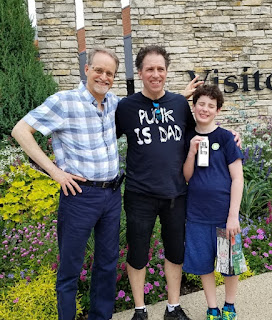
All in all, a good time was had by all. I was heartened to see that there were fans of all ages there. Many were younger than my 34-year-old son who was with me, and were not with their parents (see image below). 

For the complete setlist, see setlist.fm. This amazing website also has the 2003 Naperville TMBG setlist. It even has the setlist one of the first concerts I ever saw - in 1975: Led Zeppelin.


Wednesday, May 28, 2025

U2 Trivia Quiz

With Bono's stage piece, "Stories of Surrender," airing on AppleTV+ on Friday, it's the perfect time to test your U2 trivia knowledge. Click Answer to see the answer on each question. Note: You'll have to keep track of your score, if you find that necessary. Also, there are some negative interrogative questions, which can be tricky.

The U2 Trivia Quiz

  1. Which is NOT a former name of U2?
  2. Which is the correct age order, oldest to youngest, of the U2 members?
  3. How old was Larry Mullen, Jr when he posted the fateful notice for an audition (held in his parents’ kitchen) for what would become U2?
  4. Which group were Bono and The Edge members of?
  5. For whom has Bono/U2 NOT composed a song?
  6. Who has Bono/U2 NOT performed with?
  7. Who has Bono/U2 NOT written with?
  8. Which alter ego has Bono NOT performed as?
  9. Which member of U2 does NOT proclaim to be Christian?
  10. Which nickname was NOT given among the early U2 cohort?
  11. Who was only briefly a member of the band that would become U2?
  12. What school did all of U2 attend?
  13. Which Producer has U2 NOT worked with?
  14. Which conflicted area has U2 (or members) NOT performed in?
  15. Which religious leader has Bono NOT met?
  16. Which political leader has Bono NOT worked with?
  17. At which College or University was Bono a student?
  18. Bono's mother, Iris, only saw him sing in performance once, in a school production of Joseph and the Amazing Technicolor Dreamcoat. What role did Bono play?
  19. Which recording studio was NOT used by U2?
  20. Which venue has U2 NOT performed in?

Sunday, April 6, 2025

My Quiz on Music, the Universe, and God

If you missed the Facebook and Instagram invitations to my SurveyMonkey quiz, here's a chance to take almost the same quiz directly on my Blog. You can comment on it, and we'll trust you to tell us how many you got right.

Who said it?

  1. "If I should ever die, God forbid, let this be my epitaph: The only proof he needed for the existence of God was music."
    • John Lennon
    • Kurt Vonnegut
    • Pete Townshend (The Who)
    • Stephen Colbert

  2. "I don't profess to be a practicing Christian although I think Christ was what he was and anybody who says something great about Him, I believe."
    • Elvis Presley
    • Bono (U2)
    • Elton John
    • John Lennon

  3. "The background of our music is a spiritual-blues thing... we're making our music into electric church music - a new kind of Bible you carry in your hearts, one that will give you a physical feeling. We try to make our music so loose and hard-hitting so it hits your soul hard enough to make it open. [Rock] is more than music, it's like church, like a foundation for the lost or potentially lost... we're trying to save the kids, to create a buffer between young and old. Our music is shock therapy to make them realize a little more of what their goals should be. We want them to realize that our music is just as spiritual as going to church. The soul must rule, not money or drugs. You should rule yourself and give God a chance..."
    • Bob Dylan
    • Sly Stone
    • Jimi Hendrix
    • Carlos Santana

  4. "My first love would be spiritual music."
    • Michael W. Smith
    • Elvis Presley
    • George Harrison
    • Billy Preston

  5. "Music has always been religious. Music is a passion and a vehicle for the understanding of why we are here. It's a remembering of the past and of ritual."
    • Jon Anderson (Yes)
    • Carlos Santana
    • Timothy Leary
    • Twila Paris

  6. "I think art can lead you to God. I think that's the purpose of everything. If it's not doing that, what's it doing? It's leading you the other way. It's certainly not leading you nowhere."
    • Bob Dylan
    • T-Bone Burnett
    • Ian McCulloch (Echo & the Bunnymen)
    • Johnny Cash

  7. "Christianity has survived Christians for over two thousand years now, which from my point of view is evidence that maybe something is going on there."
    • Bob Dylan
    • T-Bone Burnett
    • Bono (U2)
    • Tim Robbins

  8. "Everything else can wait, but the search for God cannot wait."
    • Bono (U2)
    • George Harrison
    • Rick Warren
    • Carlos Santana

  9. "Here I was, a young man, and suddenly my dream came true, which was to become a successful musician. Actually, successful far beyond my expectations. You hand a young guy everything this world says is success and what is supposed to be fulfilling. We were very well off financially; we had our pick of the girls; we had Porsches, yachts, and all that kind of stuff. Then you find that that’s really not it."
    • Kerry Livgren (Kansas)
    • Mac Powell (Third Day)
    • Pete Townshend (The Who)
    • John Lennon

  10. "The more I would try to sing about the universe destroying me, the universe being dark and mysterious, the more I sounded like I was worth listening to. It's strange. It's like, the guy who'll get up there in front of people and not be afraid of humiliation is the most powerful guy in the room. The more insignificant I thought I was, the more significant I think I sounded. The more I admitted I was helpless, the more powerful I became."
    • Mac Powell (Third Day)
    • Wayne Coyne (Flaming Lips)
    • Jon Anderson (Yes)
    • Chris Martin (Coldplay)


Saturday, June 29, 2024

Steve Albini and I

This is not another one of my profiles of Christians. Indeed, the final song on his Shellac album that was released just after he died on May 7 was titled “I Don’t Fear Hell.” Nevertheless, he was a compelling person.  

After Steve Albini died, I wanted to share my experiences with him, mostly from 40 years ago. Looking back, he seems so different than the Steve of recent years. What I did begin to see was that, in contrast to the attitudes of many today, people can be redeemed. I don’t mean in the Christian sense, but who am I to judge? 

I’m not qualified to write an obituary of Steve, nor can I claim him as a true friend. Many people who only superficially encountered him or his music tended to avoid him back in the day. He could be abrasive. And offensive. And not just to afflict the powerful. Punching up, but also down and sideways. Back then, I had tried to understand how deep that abrasive front was. And now I want to understand how that changed.

Why did I befriend such a person? My wife might say that I want everyone to like me, so I was working on getting him to like me. Neil Steinberg says he felt that Steve wanted people to hate him, so, he wouldn’t give Steve that pleasure, and instead was nice to him.

Steve Albini is very important to a certain group of hardcore punk fans. I had some experience with the punk movement back in the late 1970s and early 80s. My brother Nathan started one of the first punk bands in my hometown, Washington, DC. Ian MacKaye went to my high school, and Henry Rollins (né Garfield) was also around. (For my recollections of that time, see “Punk Turns 60” in Related Links below.) At Northwestern University, I was in a band (The Front Lines) that covered some punk songs, but many other songs as well.

When I first met Steve at Northwestern, I was working at The Comp Shop in the Norris University Center (student union), where The Daily Northwestern was composed. We also did other work for students, such as resume typesetting and photo enlarging. I was a junior in the fall of 1980, and Steve was a freshman. He wanted a reduction of a drawing he had done, and I happened to be the one to interact with him. He found our prices somewhat too high, and we debated the finer points of non-profit versus not-for-profit enterprises. Nevertheless, I didn't set the prices. His drawing was leaning to the style of Ralph Steadman if I recall correctly. He was definitely talented, and I would see more of his work later, as would readers of the Daily Northwestern.  

The next time I remember seeing him, he was playing a bass, which was duct-taped to his belt (or where a belt would be) instead of using a strap, outside on the Northwestern University lakefront, northeast of Norris Center. He was playing with a band which included Bob Orlowsky (a WNUR DJ) and the band’s name was - I would only recently find out - Small Irregular Pieces of Aluminum. They played a song I knew by The Stranglers, “Hanging Around,” and Bob would mime being crucified. I thought, is that what this song is about? 

Meanwhile, there was another NU band whose bass player liked to wear a “Punk Rock Sucks” T-shirt with a cartoonish screaming punk singer on it. I, on the other hand, appreciated punk as a musical genre or defiant statement, but it never became a way of life for me.

Sometime later, at an NU off-campus party, we discussed music. He said he wasn't a Beatles fan (maybe he said he hated them), but I listed some songs I thought he might like, given his taste. He admitted that he did like "I'm Down." I already knew he didn't like The Front Lines (“unoriginal” he wrote in the Daily Northwestern), but he said Sam Fishkin played him our first demo tape, which he did like. Sam had engineered our first demo, our 4-song E.P. and our single. Indeed, Sam had toured with The Front Lines as sound engineer in July of 1981, for seven dates out east. In 1982, Sam helped Steve record Lungs as Big Black by lending him a 4-track tape deck. 

I only vaguely remember Steve’s Big Black gig at the Paradise shack at Northwestern. I think he was playing loud distorted electric guitar by himself with a drum machine or tapes. Steve asked me after performing whether a certain young woman had shown up, but I didn’t know her, nor did I see any likely candidate. I vaguely remember him smoking Kretek “clove” cigarettes. Maybe not, but there was a subculture at NU that smoked them.

I would run across Steve from time to time in Norris. In May of 1982, he handed me an invitation that said “Throw Things at Steve Albini.” He said it was for an art class “performance art” assignment, and that he hated performance art.

The two-part invitation Steve gave me, which I found a year after publishing this article,
while not looking for it.

I had an idea almost immediately. Earlier that year, wandering home through an alley near the Evanston duplex I shared, I found a decrepit classical guitar sticking out of a trash can. Finders, keepers! I took it in hopes that I would find a use for it, maybe smash it on stage someday.

Invitation as it appeared in The Daily Northwestern on May 4, 1982

That Friday (May 7), I brought it to work at the Comp Shop. From some of the windows there on the 3rd floor, I could see Steve and some buddies out back, setting up the acrylic “glass” framed like a door with 2x4s, based on perpendicular boards. The next time I looked though, there was a hole in the acrylic, and it wasn’t even time to start. I went out to ask what happened. Someone told me the first test was a grapefruit and it went right through the acrylic sheet. (I recently read Steve’s Daily Northwestern article of May 12, which stated that the first object was a bowling pin, which did indeed make a hole.)

I went back upstairs and got the guitar, which was still in one piece but not playable. Back on the lawn, I waited in line for my turn. Someone threw a baby chick, which someone else rescued. When my turn came, I hurled the guitar which, not having the heft of a solid-body electric, didn’t even make it to the base of the structure. I ran up, grabbed the guitar by the neck like an axe (like Townsend, Hendrix, and Simonon before me), and smashed it on the base of the structure, and tossed it through the already gaping hole in the acrylic. As I did this, Steve says “No cheating!” Cheating? What are rules to you, Steve? Anyway, I had no effect on the structure.

All in all, it was the best performance art piece I have ever seen or heard of.

Aftermath of the art. It's not quite a Christ-like pose. You can see my guitar neck in the lower right.  Photo courtesy Lori Montgomery.

In my senior year, I took two consecutive art classes with Ed Paschke. The first was Intermediate Painting, for which I had no collegiate experience, just high school art class. But I had a desire to learn from Ed Paschke, whose art I was familiar with, and an elective to fill. The second was Advanced Drawing, which I did better in than the painting class. Steve (then a sophomore) was in both classes.

Both classes were in studios, not classrooms. A lot of time in each class was devoted to discussion about art while sitting or working in front of our easels: creativity, styles of painting or drawing, improvisation or inspiration versus planning or purpose. Paschke led the class like a Socratic Mister Rogers, asking questions, gently guiding discussion, but not dictating or demanding assent. Sometimes it seemed like it was a friendly debate between Steve and me (the biggest mouths in the class) with Paschke moderating.

The Advanced Drawing class was more active. For example, there were a couple of assignments involving random chance. One involved starting with something random, then building upon it. I shook a can of Coke and let it spray on some drawing paper. After it dried, I used that as a basis for an alien planet landscape, in pencil.

Later in the quarter, Paschke invited the class down to his art studio in Chicago, on Howard Street. Sitting around with refreshments, we discussed planning versus improvising in art. Steve took up the improvised side. Paschke asked Steve if he preferred films directed by Robert Altman or Alfred Hitchcock. Steve said he hated Altman and loved Hitchcock. Paschke said that Altman was known for encouraging actors to improvise, while Hitchcock was known for storyboarding every shot. I think Steve was speechless. He may have been reassessing his opinion.

At one off-campus party we were both at – I think it was June 1982 because I remember Joe Jackson’s Night and Day album was playing – we discussed his unrequited affection for a female classmate. It was a remarkably normal conversation. 

Though I graduated shortly thereafter, I didn’t go far from NU. I continued living in Evanston until moving to Chicago in 1984 and worked in Evanston even longer. Still there in the summer of 1982, Steve asked to borrow $20 from me, partially to see The Gang of Four, which I was also going to, at Stages (a.k.a. Metro) in Chicago, on July 23, 1982. Sara Lee played bass and they had a back-up singer, touring to support the album Songs of the Free. Steve repaid the loan and gave me two cassette tapes: “Big Black songs 3-82/5-82” and The Cure, Pornography b/w "Dance or Die" mix. He wrote a long positive review of the concert for The Summer Northwestern on July 30, 1982.

In 1983 and 1984, we were both writing for the indie fanzine Matter: a music magazine, so I have some copies of it. Among the many harsh criticisms of bands, fans, and music scenes you might expect, there are occasional “homo” insults in his column, Tired of Ugly Fat? For example, “The Cure gave us Pornography [album] and a lovely live single, then went homo in a big way with the abysmal single ‘Let’s Go to Bed.’” (Matter No. 2). In Matter No. 5, he defended some transgressive bands:

“a joke’s a joke and nobody – not the anti-obscenity league, and certainly not some weekend punk philosopher – is going to call some of them off bounds. No rules means no rules.
     “That’s not to say that disgusto humor is the only answer, or that all disgusto humor is cool. In fact, I’m not crazy about a good deal of it, but if it’s funny or makes a point, it would be stupid to write it off because it doesn’t conform to somebody’s idea of acceptability.”

Around this time, I ran into Steve in Norris Center and he told me his second Big Black record would be titled “Hey N*gg*r.” Are you serious?!  He says “It’s not me saying it. It’s Bob and Billy Six-Pack.” So it’s supposed to be social commentary, not racist? I say, “Well, I wouldn’t blame some black guy for punching you in the face.” He considered it, and said, “I can see that.” Well, he didn’t title it that, but according to Wikipedia, his bandmates convinced him not to. The title became “Bulldozer” instead. I didn’t think he was serious, but thought he was just testing me: Would I be offended, or would I agree, or what would I say?

But Steve was beginning to listen to his critics. In Matter No. 8, in response to a letter to the editor criticizing his “hetero-white-boy smug bullshit”, Albini responds, “Several people have brought to my attention how much overt fag baiting I’ve been doing. Having re-read much of what I’ve written, I have to agree. That’s not why I do this, and I don’t want it to appear that way. It takes letters like yours to make people like me rethink old habits.”

I’m reminded of a discussion I had with someone else about a work colleague at that time. We mused over how much intolerance we should tolerate. How intolerant should we be of the intolerant? Today, many people act as though the answers are easy, but in the early 1980s it wasn’t that way. Reagan was president, the Moral Majority was ascendant, hardcore punk was still underground, and rap had only begun to take shape.

Steve in the 1984 Syllabus NU yearbook.
Before selfies, the yearbook had a wired remote camera feature called "Shoot Yourself."  

In the same yearbook, some 1984 Comp Shop staff: Kier, Lucille, Melanie, and Sheena.

I had not thought of Steve for some years, and not spoken to him in decades, then watched Sonic Highways, the 2015 HBO series featuring Dave Grohl and Foo Fighters in eight different cities (primarily because my brother was in the DC episode). In the Chicago episode, we find Steve, now married, somewhat mellower, running a beautiful recording studio that he built, and making money playing competitive poker. Albini had recorded In Utero with Nirvana (which included Dave Grohl as drummer) in 1993, famously forgoing producer royalties as he always did, charging a flat fee as an engineer. I already knew that. It showed him to be iconoclastic, serious, and principled, as well as famous. In 1995, Steve bought the building that would become Electrical Audio, which opened for business in 1997.

In the Sonic Highways episode, a couple of people recall the earlier Steve as a “cynical prick.” Former Big Black member and Naked Raygun singer Jeff Pezatti said, especially regarding Steve’s non-producer ethics, that Steve was “very righteous… to a fault.” LCD Soundsystem singer James Murphy tells how when he started in Brooklyn, no recording studio wanted to help him, so he wrote a letter to Albini asking how to create a recording studio. Steve responded with detailed instructions including diagrams of room acoustics, the generosity of which surprised Murphy, then an unknown. Another musician says that everything used to be black and white with Steve; now there’s some gray. Yet another says, “Now Steve can say ‘love.’”

By this time, I had become a Christian. I got the idea that it would be ironic to have a song I wrote recorded at Electrical Sound as performed by a gospel band. What I didn’t yet know is that Christian punk bands had already been recorded by Steve.

In March of 2021, I read a piece in Rolling Stone about a cat that Steve had taken a liking to. He wrote the introduction to a book about Lil Bub the cat (see Related Links, below). Reading that introduction and trying to ascribe it to the Steve of the 1980s is impossible. He had certainly matured. (Watching the Sonic Highways segment again, I noticed that he has Lil Bub with him in one shot.)

His wife, Heather Whinna, co-directed a documentary about Christian punk music, Why Should the Devil Have All the Good Music? She started the Letters to Santa program for Poverty Alleviation Chicago and in 2002 organized an annual 24-hour marathon Christmas benefit music and improv comedy concert with Steve, featuring the likes of Jeff Tweedy of Wilco. She had to have been part of his evolution.

In September of 2021, Neil Steinberg (my roommate freshman and sophomore year and friend ever since) called me from his car. He now writes for the Chicago Sun-Times (not to mention a daily blog and nine books). He just had to tell me what Steve had said about me in an interview he had just finished. After Neil told Steve he was my roommate at NU… here’s the transcript:

Steve: Kier Strejcek is actually an important musical figure. His brother, Nathan Strejcek was in The Teen Idles with Ian MacKaye who later started Minor Threat and Fugazi.

Neil: Can I tell him you said that?

Steve: He knows that. It’s his brother.

Neil: No, that he’s an important musical figure.

Steve: He was revered. He was the big brother, well literally, to the hardcore punks in Washington, DC who started a movement. He was sort of seen as the older brother who knew... he learned to play guitar before everybody else. He was in bands before everybody else. He moved away, he had a band when he moved out here. He’s a seminal though not necessarily critical figure."

Neil: He’s a nice guy.

Steve: A super nice guy. He worked at the print shop as well.

Okay, I believe that he said I was a nice guy. I did lend him money. But I seriously doubt that anyone was or is revering me back in DC. I was there in April and not one person showed me reverence. I would think Glenn Kowalski (in the band White Boy) might have been more “seminal.” At least I was in a band with him. Actually, if you ask me, The Razz and The Slickee Boys were proto-punk in DC. Steve did not get this idea from me. Maybe from Ian MacKaye? I doubt it. From some of the multitude of punk and other musicians who he has recorded? Maybe he connected the dots himself. When I first met him, The Teen Idles didn’t yet exist. It is true that The Front Lines, the band to which Steve referred, had already been covering some punk songs in our repertoire. I decided to call Steve. 

I called him after first looking at the Electrical Audio website and the whole studio environment which is beautiful. I told him I didn’t think of myself as the older brother of DC punk. He said he thought I was “patient zero” for punk in DC. I decided not to strenuously argue the point. If he wanted to believe that, it was all right by me. We chatted about ancient history briefly. I asked about the studios. He said he would only record in the analog studio, but there is also a digital studio. I asked about timing, both how far into the future they were booked, and how the days went there (from 10 or noon up to 10 hours), and they charge per day (not hourly). We both had to get back to work, and we never spoke again.

I had hoped to record at least one specific song there (not the aforementioned gospel song), maybe next year. Now it would have to be without him, unfortunately. Writing this piece, I kept wishing he was around to verify my recollections.

I see in Steve Albini artistic self-reliance and self-confidence, even in the face of daunting opposition. I see success as defined by the person, even in the face of social and economic pressure. He was a standard-bearer for DIY bands and the rights of musicians against record companies. We also see someone whose words (and some actions) needlessly antagonized, offended, or hurt people. Yet he seemed to have confessed and repented of many of the hurtful things. Some of us need more of that courage, and yet more of us need that humility. 

Related Links

My blog about my brother Nathan: Punk Turns 60

The Guardian, Aug 15, 2023: The evolution of Steve Albini: ‘If the dumbest person is on your side, you’re on the wrong side’

Neil Steinberg, Chicago Sun-Times on Steve Albini:

·       ‘I want the music to survive’ Sept 6, 2021

·       ‘Success means I get to do it again tomorrow’ Sept 8, 2021

·       Steve Albini: The last genuine punk rocker May 9, 2024

·       “I’m a weirdo; all my friends are weirdos” — more from Steve Albini May 14, 2024

Rolling Stone, Mar 23, 2021: Read Steve Albini’s Tribute to Lil Bub in New Book, Lil Bub: The Earth Years

Chicago Magazine, 1994: Steve Albini and the Life of the Iconoclast

Matthew Smith-Lahrman interview of Steve, 1993

New York Times, May 8, 2024: Steve Albini, Studio Master of ’90s Rock and Beyond, Dies at 61

The Front Lines: For details, see Strejcek.net/bands.html.


Tuesday, August 16, 2022

Salman Rushdie and U2

The attack on Salman Rushdie reminded me of an article he wrote for The Nation magazine in 2001. It was about his involvement with the band U2, and a song that appears only on the UK version of All That You Can’t Leave Behind, and on the soundtrack to the movie The Million Dollar Hotel. The words to “The Ground Beneath Her Feet” were written by Salman Rushdie, who had a fatwa (death sentence) pronounced on him by Iran’s Ayatollah in 1989 because of his book, The Satanic Verses. Read what happened in Rushdie’s own words, which are quite entertaining, at The Nation: The Ground Beneath My Feet. (I copy the article in its entirety below.) The video for the song, which features scenes from The Million Dollar Hotel, is here: https://www.youtube.com/watch?v=sZfBR5G8FZ8. Rushdie can be seen in the video in a window from 0:20 to 0:32.

The Ground beneath My Feet

By Salman Rushdie

In the summer of 1986 I was traveling in Nicaragua, working on the book of reportage that was published six months later as The Jaguar Smile. It was the seventh anniversary of the Sandinista revolution, and the war against the US-backed contra forces was intensifying almost daily. I was accompanied by my interpreter, Margarita, an improbably glamorous and high-spirited blonde with more than a passing resemblance to Jayne Mansfield. Our days were filled with evidence of hardship and struggle: the scarcity of produce in the markets of Managua, the bomb crater on a country road where a school bus had been blown up by a contra mine. One morning, however, Margarita seemed unusually excited.

"Bono's coming!" she cried, bright-eyed as any fan, and then added, without any change in vocal inflection or dulling of ocular glitter, "Tell me: Who is Bono?"

In a way, the question was as vivid a demonstration of her country's beleaguered isolation as anything I heard or saw in the frontline villages, the destitute Atlantic Coast bayous or the quake-ravaged city streets. In July 1986, the release of U2's monster album The Joshua Tree was still eight months away, but they were already, after all, the masters of War. Who was Bono? He was the fellow who sang, "I can't believe the news today, I can't close my eyes and make it go away." And Nicaragua was one of the places where the news had become unbelievable, and you couldn't shut your eyes to it, and so of course he was there.

I didn't meet Bono in Nicaragua [in 1986], but he did read The Jaguar Smile. Five years later, when I was involved in some difficulties of my own, my friend the composer Michael Berkeley asked if I wanted to go to a U2 Achtung Baby gig, with its hanging psychedelic Trabants. In those days it was hard for me to go most places, but I said yes and was touched by the enthusiasm with which the request was greeted by U2's people. And so there I was at Earl's Court, standing in the shadows, listening.

Backstage, after the show, I was shown into a mobile home full of sandwiches and children. There were no groupies at U2 gigs; just crèches. Bono came in and was instantly festooned with daughters. My memory of that first chat is that I wanted to talk about music and he was keen to talk politics--Nicaragua, an upcoming protest against unsafe nuclear waste disposal at Sellafield in northern England, his support for me and my work. We didn't spend long together, but we both enjoyed it. Bono was less taken with Michael Berkeley, however. Years afterward he told me he'd felt condescended to by the classical composer. My own view is that there was a misunderstanding--Michael isn't a condescending man, but a high culture/low culture rift had opened, and that was that.

Two years later, when the giant Zooropa tour arrived at Wembley Stadium, Bono called to ask if I'd like to come out on stage. U2 wanted to make a gesture of solidarity, and this was the biggest one they could think of. When I told my then-14-year-old son about the plan, he said, "Just don't sing, Dad. If you sing, I'll have to kill myself." There was no question of my being allowed to sing--U2 aren't stupid people--but I did go out there and feel, for a moment, what it's like to have 80,000 fans cheering you on. The audience at the average book reading is a little smaller. Girls tend not to climb onto their boyfriends' shoulders during them, and stage-diving is discouraged. Even at the very best book readings, there are only one or two supermodels dancing by the mixing desk. Anton Corbijn took a photograph that day for which he persuaded Bono and me to exchange glasses. There I am looking godlike in Bono's wraparound Fly shades, while he peers benignly over my uncool literary specs. There could be no more graphic expression of the difference between our two worlds.

It was inevitable that both U2 and I would be criticized in Britain in bringing these two worlds together. They have been accused of trying to acquire some borrowed intellectual "cred," and I of course am supposedly star-struck. None of this matters very much. I've been crossing frontiers all my life--physical, social, intellectual, artistic borderlines--and I spotted, in Bono and Edge, whom I've come to know better than the others so far, an equal hunger for the new, for whatever nourishes. I think, too, that the band's involvement in religion--as inescapable a subject in Ireland as it is in India--gave us, when we first met, a subject and an enemy (fanaticism) in common.

An association with U2 is good for one's anecdote stock. Some of these anecdotes are risibly apocryphal: A couple of years ago, for example, a front-page Irish press report confidently announced that I had been living in "the folly"--the guest house with a spectacular view of Killiney Bay that stands in the garden of Bono's Dublin home--for four whole years! Apparently I arrived and departed at dead of night in a helicopter that landed on the beach below the house. Other stories that sound apocryphal are unfortunately true. It is true, for example, that I once danced--or, to be precise, pogoed--with Van Morrison in Bono's living room. It is also true that in the small hours of the following morning I was treated to the rough end of the great man's tongue. (Van Morrison has been known to get a little grumpy toward the end of a long evening. It's possible that my pogoing wasn't up to his exacting standards.)

Over the years U2 and I discussed collaborating on various projects. Bono mentioned an idea he had for a stage musical, but my imagination failed to spark. There was another long Dublin night (a bottle of Jameson's was involved) during which the film director Neil Jordan, Bono and I conspired to make a film of my novel Haroun and the Sea of Stories. To my great regret this never came to anything either.

Then, in 1999, I published my novel The Ground beneath Her Feet, in which the Orpheus myth winds through a story set in the world of rock music. Orpheus is the defining myth for singers and writers--for the Greeks, he was the greatest singer as well as the greatest poet--and it was my Orphic tale that finally made possible the collaboration we'd been kicking around.

It happened, like many good things, without being planned. I sent Bono and U2's manager, Paul McGuinness, pre-publication copies of the novel in typescript, hoping they would tell me if the thing worked or not. Bono said afterward that he had been very worried on my behalf, believing that I had taken on an impossible task, and that he began reading the book in the spirit of a "policeman"--that is, to save me from my mistakes. Fortunately, the novel passed the test. Deep inside it is the lyric of what Bono called the novel's "title track," a sad elegy written by the novel's main male character about the woman he loved, who has been swallowed up in an earthquake: a contemporary Orpheus' lament for his lost Eurydice.

Bono called me. "I've written this melody for your words, and I think it might be one of the best things I've done." I was astonished. One of the novel's principal images is that of the permeable frontier between the world of the imagination and the one we inhabit, and here was an imaginary song crossing that frontier. I went to McGuinness's place near Dublin to hear it. Bono took me away from everyone else and played the demo CD to me in his car. Only when he was sure that I liked it--and I liked it right away--did we go back indoors and play it for the assembled company.

There wasn't much after that that one would properly call "collaboration." There was a long afternoon when Daniel Lanois, who was producing the song, brought his guitar and sat down with me to work out the lyrical structure. And there was the Day of the Lost Words, when I was called urgently by a woman from Principle Management, which looks after U2. "They're in the studio and they can't find the lyrics. Could you fax them over?" Otherwise, silence, until the song was ready.

I wasn't expecting it to happen, but I'm proud of it. It's called "The Ground Beneath Her Feet." For U2, too, it was a departure. They haven't often used anyone's lyrics but their own, and they don't usually start with the lyrics; typically, the words come at the very end. But somehow it all worked out. I suggested facetiously that they might consider renaming the band U2+1, or, even better, Me2, but I think they'd heard all those gags before.

There was a long al fresco lunch in Killiney at which the film director Wim Wenders startlingly announced that artists must no longer use irony. Plain speaking, he argued, was necessary now: Communication should be direct, and anything that might create confusion should be eschewed. Irony, in the rock world, has acquired a special meaning. The multimedia self-consciousness of U2's Achtung Baby-Zooropa phase, which simultaneously embraced and debunked the mythology and gobbledygook of rock stardom, capitalism and power, and of which Bono's white-faced, gold-lamé-suited, red-velvet-horned MacPhisto incarnation was the emblem, is what Wenders was criticizing. Characteristically, U2 responded by taking this approach even further, pushing it further than it would bear, in the less-well-received POP-Mart tour. After that, it seems, they took Wenders's advice. The new album, and the Elevation tour, is the spare, impressive result.

There was a lot riding on this album, this tour. If things hadn't gone well it might have been the end of U2. They certainly discussed that possibility, and the album was much delayed as they agonized over it. Extracurricular activities, mainly Bono's, also slowed them down, but since these included getting David Trimble and John Hume to shake hands on a public stage and reducing Jesse Helms--Jesse Helms!--to tears, winning his support for the campaign against Third World debt, it's hard to argue that these were self-indulgent irrelevances. At any event, All That You Can't Leave Behind turned out to be a strong album, a renewal of creative force and, as Bono put it, there's a lot of good will flowing toward the band right now.

I've seen them three times this year: in the "secret" pre-tour gig in London's little Astoria Theatre and then twice in America, in San Diego and Anaheim. They've come down out of the giant stadiums to play arena-sized venues that seem tiny after the gigantism of their recent past. The act has been stripped bare; essentially, it's just the four of them out there, playing their instruments and singing their songs. For a person of my age, who remembers when rock music was always like this, the show feels simultaneously nostalgic and innovative. In the age of choreographed, instrumentless little-boy and little-girl bands (yes, I know the Supremes didn't play guitars, but they were the Supremes!) it's exhilarating to watch a great, grown-up quartet do the fine, simple things so well. Direct communication, as Wim Wenders said. It works.

And they're playing my song.

Salman Rushdie

Monday, January 10, 2022

Punk Turns 60

A specific punk, that is. 

Punk music is not actually 60 years old. Even if you count Iggy Pop as the “godfather” of punk, he didn’t start the Stooges until 1967. But the punk that I know best, my younger brother Nathan, turns 60 on January 10.

We were often each other’s closest playmate, and nearest opponent. I was told that when he was a toddler sitting on picnic blanket for a home movie, I pushed him over in jealousy. I didn’t believe that until I saw the Super 8 movie.

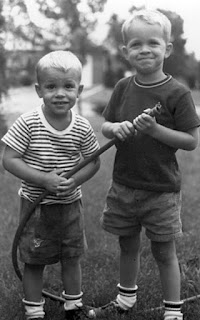
Nathan and Kier with garden hose

Sometimes the competition was more subtle, as in the photo above. Sometimes it was worse, but usually it was more fun. We grew up in Washington, DC. We were in Boy Scouts, explored the wild areas of Palisades, played tag; rode bikes; went to Washington Senators baseball games with our dad; watched Redskins football; played disorganized sports, like tackle football in a vacant lot without equipment; laughed at the Marx Brothers, then Monty Python.

As adolescents, I would try to use logic, diplomacy, or humor to deflect bullies and arguments leading to fights. Nathan, however, stood his ground and ended up fighting enemies, and friends when necessary. One time, a neighbor had Nathan pinned on the ground until the neighbor’s older brother chased him off, while I did nothing. ☹

I don’t mean to say Nathan was obnoxious or confrontational. Rather, he had a strong sense of right and wrong. He made friends with many of my friends, not to mention the neighborhood dogs. In fact, as young teens, we were both Washington Post paperboys. I was at war with some over-protective German Shepherds, but he was the pied piper of a multitude of local dogs.

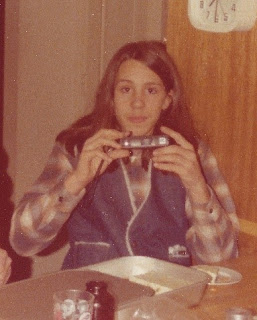
Nathan with camera and long hair

In 1975, we made a 10-minute Super 8 action movie titled Revolt!, starring 21 neighborhood kids. It wasn’t a call to revolution but involved an unnamed foreign country and many toy guns. I think the police would stop us if we were doing it today. There was a script, but it was silent with title cards. I added unlicensed copyrighted music; therefore, you wouldn’t get its full impact on YouTube.

Also in 1975, I started a rock band (Ex-Calibre) with some friends, rehearsing in our basement. We played in a church basement, at a playground, and two elementary schools. We were bad. By the next year, my new band named Djant with Glenn Kowalski (7 Door Sedan) and Max Surla was practicing in my mom’s basement. We were somewhat better, playing Beatles, Bowie, Stones, Who, and Zeppelin.

Meanwhile, Nathan’s musical taste and mine began to diverge. We had both been fans of the above bands, but I drifted towards ELP, Yes, Jeff Beck, and Return to Forever, while he got into Iggy and the Stooges.

Then 1977 and the Sex Pistols appeared. Nathan played the album for me. I was struck by the urgent, angry political challenges in “Anarchy in the UK” and “God Save the Queen” - but not converted.

Nathan, whose hair was shoulder-length like mine, said he would get a punk haircut if he had to cut his hair. When he applied for a job at the Georgetown Swenson’s ice cream shop, he was told he would have to cut his hair. Next thing I knew, he had a short spikey cut, ready for some Dippity-Do. 

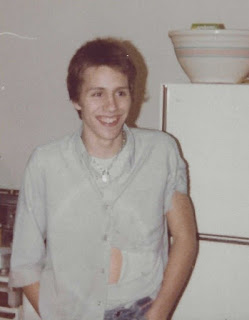
Nathan with short hair by the fridge
Nathan, age 16, in the fall of 1978.

In the fall of 1978, I went away to college. When I opened a box of records I had brought, I found that Nathan had put the Sex Pistols Never Mind the Bollocks LP on top. I did listen to it. Then I bought a Clash LP. Then The Buzzcocks, and XTC. By the time I had started a band (The Front Lines) in college in the spring, we were playing Sex Pistols, Clash, Ramones, and Elvis Costello songs, in addition to the classics, such as Dylan, Hendrix, Stones, Who, Zeppelin, and Chuck Berry. We renamed the Sex Pistols song “God Save the Dean”.

That summer back home, a couple of neighborhood bands played in a detached garage on my block. The first band was the host’s (Bryan Fox?) band. I only remember them playing “Tush” by ZZ Top. Next was The Slinkees, which was the precursor to The Teen Idles, but with Mark Sullivan singing. I remember them playing a parody of “Free Bird” called “Dead Bird,” with Sullivan shouting at the end.

Sullivan went away to college that fall, and Nathan became the singer for the band, who took a new name, The Teen Idles, for whom Slinkees bassist Ian MacKaye also played (and later went on to form Minor Threat and Fugazi). For details, see the website for Dischord, the independent record company that The Teen Idles started. 

My mom, Jody, let Nathan’s bands practice in the basement. (I should say that by this time our parents had divorced.) She would say that she filtered out the music, but one time they were practicing “Do You Love Me?” by The Contours. I was upstairs with her, and she comically rolls her eyes and says “Yes, already.” Eventually, Nathan invited other bands to rehearse in the basement, but State of Alert (S.O.A.) was one band too many for Jody. From then on, her child had to be in the band for it to rehearse there. The singer of S.O.A. was Henry Rollins, known then as Henry Garfield, who I remember stage-diving at a show with no one catching him. 

For sophomore winter break, I went home. The Teen Idles were having their first gig in our basement. I went downstairs with my long hair and a drink in my hand. It is not a large basement and didn’t take much to be crowded. I was leaning against a post, with people behind me standing and people in front of me dancing. It wasn’t pogoing or slam-dancing; maybe bounce-off-people dancing. Someone threw a beer all over me, and I reflexively threw my drink back. Someone else lunged at me, but he was pulled back by Nathan, who yelled above the song, “No Fun” by The Stooges, “That’s my brother, you idiot!” 😊

By the end of 1980, The Teen Idles had broken up, having released one 8-song EP. Nathan started his next band, Youth Brigade, with his best friend and future best man at his wedding, Danny Ingram, on drums. 

The Teen Idles and Youth Brigade are both considered “hardcore” punk and “straight edge”, the latter meaning abstaining from alcohol and drugs. Songs like “Waste of Time” and even “I Drink Milk” were straight edge songs.  

Photo by Lloyd Wolf, from Banned in DC. Nathan is wearing a sweater Jody knitted under the leather jacket.
Photo by Lloyd Wolf, from Banned in DC.
Nathan is wearing a sweater Jody knitted under the leather jacket.

In the summer of 1981, The Front Lines made a short 7-city tour, stopping in DC to play at the Cellar Door. The band, seven young men including roadie and sound man, slept all around my mom’s house. Unfortunately, Youth Brigade had a gig that same night, so we did not get to see each other’s bands.  

Later that summer, Youth Brigade, Minor Threat, and The Necros played at O’Banion’s in Chicago. Youth Brigade and some of the Necros stayed at Phil (Front Lines singer) and my two-bedroom off-campus apartment in Evanston. (This was the summer between junior and senior of college year for me.) I don’t remember too much of the show, but the Revolutionary Communist Youth Brigade, an actual communist party youth group, showed up, perhaps thinking there was a common interest in Marxist revolution. I remember an argument outside the club afterwards. The RCYB was evangelizing for a revolution, and I think it was Ian who said that if there was a revolution, the RCYB would get their brains bashed in.

Nathan and I have had arguments about music. As I said, I was not converted to punk. I never got the requisite haircut, though my hair kept getting shorter. My problem with punk was that anger is an emotion, but there are other emotions. Nathan didn’t stay 100% into hardcore punk though. He pointed out in the book, Banned in DC, that after slam-dancing took over, the bands got tougher, and the scene got male-dominated and macho. Over the years, he has often sent me mix tapes, later CDs, of bands he wants me to listen to, such as Siouxsie and the Banshees, Midnight Oil, The Rezillos, and more obscure bands. But they weren’t hardcore punk.

As the years went on, I lived in Illinois: Evanston, Chicago, Lisle, Naperville. Usually I would visit DC once (for Christmas) or twice a year. During that time, Nathan sang for Mister Id in 1987, as well as Mercy Bucket in 1988. You might have noticed the pun nature of their band names. Later, he would play bass for Land of the Lost, The Vague Rants, and Dear Season.

In 1989, I attended a Chicago Halloween party as Groucho. I got into a conversation with a punkish young woman there. She did not believe that I was Nathan Strejcek’s brother. She knew who he was and thought I was lying to impress her. I showed her my driver’s license to prove it. He was nationally famous, even several years after The Teen Idles and Youth Brigade had disbanded. 

Nathan married, moved out of the city, had a son, divorced, remarried, moved back into the city, got two dogs.

My brother Nathan and sister Mardi with Tundra the puppy.

Nathan can be self-deprecatingly funny. Once, when I was visiting DC with my wife and two sons, he bemusedly told me about fan mail from Brazil – now he was internationally famous! I told my kids that Nathan had been the singer in a famous band. He said, “I wouldn’t call it singing, exactly.”

Fifteen years ago, at our cousin’s wedding in Tennessee, we stayed at the Smokehouse Lodge, which had a tennis court. Nathan has usually been able to beat me at most sports, but I thought he had put on some weight, so I’d have it easier. Nope. Still beat me at tennis. I should say that Jody played tennis, and her father coached high school tennis, and we had lessons, but I still wasn’t any good.

As I said, I wasn’t converted to punk, but in 2010 I did convert to Christianity. I tried using music to witness to Nathan. For example, “The Seeker” or “Bargain” by The Who. No results so far.

A couple of times visiting DC with my wife and kids, we had jam sessions in Jody’s basement. There always seems to be a band set-up there. My kids on drums or guitar, Nathan on bass, me on guitar, both singing “House of the Rising Sun” segueing into “Stepping Stone” (a staple punk cover of The Monkees).

Youth Brigade played a reunion gig promoting the punk documentary film Salad Days at the Black Cat in DC in December 2012. I went with my sister Mardi. It was fun to see Nathan on the stage again. After the show, Nathan complained that jumping was harder than it used to be. Well, he was 50. Ian MacKaye came backstage and recalled the O’Banion’s gig. I told the RCYB story, but what he remembered was that it was supposed to be an all-ages show, and he was pissed that they were only letting adults in.   

Youth Brigade also got back together for a "punk-funk" show with Trouble Funk (DC “go-go” funk band of 80s fame; “Drop the Bomb”) in February of 2013. The “punk-funk” bill has been a cross-cultural, interracial tradition. Minor Threat and Dave Grohl have also played with Trouble Funk. 

Me, Nate, and his son at Morton Arboretum, Lisle, Illinois, August 2018.

Several years ago, my younger son had a girlfriend whose stepdad was awed that Nathan Strejcek was his uncle. My son was impressed. Nathan is still famous. He still gets royalties from Teen Idles and Youth Brigade records. He currently plays bass for The Delarcos (see below).


Happy Birthday, Nathan!